
Predicting your baby's gender: 8 methods (and what actually works)
By Yasmine, co-founder of Baby-Hunch and mum of two.
You are pregnant, your bump is growing, and everyone around you has an opinion: "It must be a boy, because you are carrying so low!" Sound familiar? Predicting your baby's gender is probably as old as pregnancy itself. From Chinese calendars to swinging a ring above your belly: there are dozens of methods for guessing whether it will be a boy or a girl.
But do they actually work? I have tried them myself (twice, in fact) and we have analysed data from more than 79,000 parents on Baby-Hunch. Here is what we found.

First, the facts: what does our data say?
At Baby-Hunch, we have a unique advantage: we do not only see what people predict, but also what the actual outcome was. After analysing 8,618 baby pools with at least 3 participants, we reached a surprising conclusion:
In 61.5% of pools, the majority correctly predicted the gender.
That is more than the 50% you would expect based on pure chance. Coincidence? Intuition? Or do people know more than they think?
Another fun fact: there is a slight boy-bias in the predictions. 51.7% of all guesses say "boy," while the actual split is a perfect 50/50 (6,685 boys vs. 6,684 girls in our data). Apparently, people guess "boy" just a little more often.
On average, 15 people participate in a baby pool (with outliers well above 100). Our record? A pool with 908 participants: an influencer couple shared their baby pool on Instagram and their followers went all out. My sister texted me: "OMG, they are using your tool!" I did not even know them.
1. The Chinese gender calendar
How does it work? An ancient Chinese chart cross-references the mother's age (lunar age) with the month of conception to determine the gender. The calendar is said to be over 700 years old and was reportedly found in a royal tomb in Beijing.
Reliability? Scientific research gives the Chinese calendar a score of approximately 50%: no better than flipping a coin.
Also read: What is a baby shower? →I tried the Chinese calendar with both of my pregnancies. Score: 0 out of 2. For my daughter, the calendar said "boy"; for my son, it said "girl." Reversed intuition would have worked better!
2. Nub theory
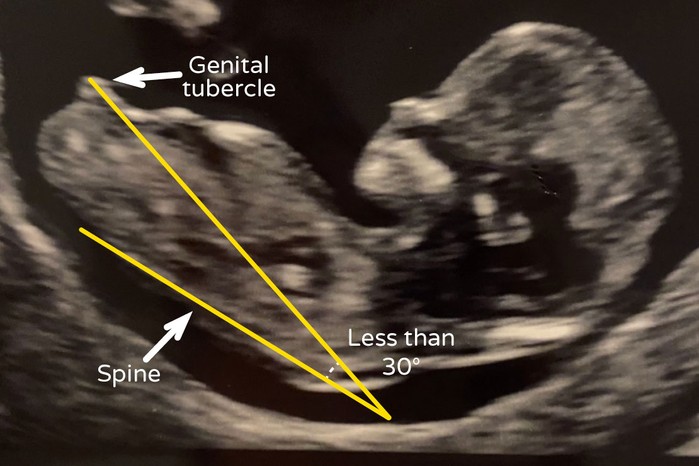
How does it work? At the 12-week scan, a small protuberance (the "nub") is visible between your baby's legs. In boys, this nub sits at an angle of more than 30 degrees relative to the spine; in girls, the nub lies more horizontally.
Reliability? This is one of the few methods with some scientific backing. At 12 weeks, reliability is around 77%; at 13 weeks, around 79%. Not watertight, but better than most other methods.
Note: you need a clear lateral ultrasound and it helps if your baby is lying on its back. Not every scan is suitable.
3. Pregnancy cravings
How does it work? According to this old wives' tale, if you are carrying a girl you crave sweet and fatty foods, while with a boy you crave sour, fresh, and savoury foods.
Reliability? There is no scientific evidence for this. Cravings are caused by hormonal changes and nutritional deficiencies, not by your baby's gender.
My experience: With my daughter, I did indeed crave sweet and fatty foods. With my son, it was fresh fruit and citrus. So for me, it happened to be correct! But two pregnancies is hardly a scientific study.
4. The bump shape
How does it work? Carrying high and wide? It is a girl. Low and pointy? A boy. This is perhaps the most well-known old wives' tale.
Reliability? None. The shape of your bump is determined by your body type, muscle tone, the position of the baby, and whether it is your first pregnancy. Not by the gender.
My experience: I carried differently with both pregnancies, and yes, it matched the "tale." But I also had a different body the second time around (spoiler: that changes a bit after your first child).
5. The ring test
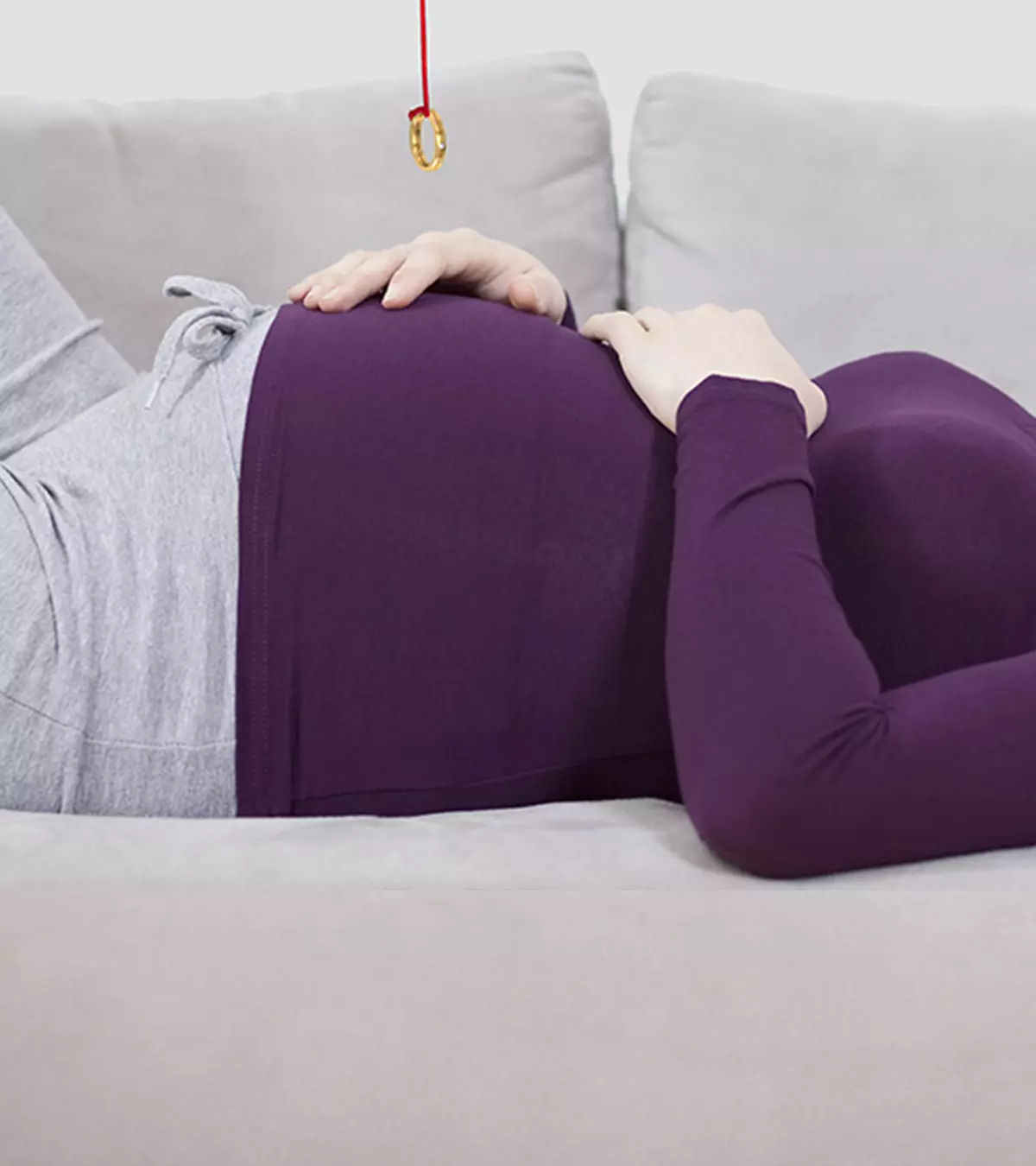
How does it work? Hang your wedding ring or another ring on a thread and hold it above your bump. Does the ring move in a circle? Girl. Does it swing back and forth? Boy. You will also see this method done with a needle and thread.
Reliability? This is the ideomotor effect: unconscious muscle movements in your hand guide the ring. It has nothing to do with the gender, but it is a fun game for a baby shower.
6. The baby's heart rate
How does it work? A heart rate above 140 beats per minute supposedly means a girl; below that, a boy.
Reliability? A large 2006 study involving nearly 10,000 pregnancies found no correlation whatsoever between heart rate and gender. The heart rate varies throughout the pregnancy and depends on the baby's activity, not its gender.
7. The moon phase
How does it work? According to this theory, the phase of the moon at conception determines the gender. Was it a full moon? Then a girl. New moon? A boy. The exact rules vary by source.
Reliability? There is absolutely no scientific evidence for this. But it is romantic.
Tip
8. Let everyone guess!
How does it work? This is the most fun method: let your entire family, circle of friends, and colleagues guess what it will be. No pseudoscience needed, just pure intuition and a lot of fun.
Reliability? Our data shows that the group gets it right in 61.5% of cases. That is better than the Chinese calendar, the moon phase, and the bump shape. Perhaps the wisdom of the crowd really is the most powerful "instrument."
With our own little boy, 9 out of 13 participants correctly predicted it would be a boy. But that same group unanimously predicted brown eyes (my husband and I both have brown eyes), and out came a blond boy with bright blue eyes. Nature cannot be fully predicted, and that is exactly what makes it so wonderful.
On Baby-Hunch, you can start a baby pool for free and let everyone guess: not just the gender, but also the due date, weight, length, hair colour, eye colour, and name. After the birth, we automatically calculate who guessed best.
So: can you really predict the gender?
Honestly? No. No method (other than an ultrasound after 20 weeks or a NIPT test) can determine the gender with certainty. The Chinese calendar scores 50%, nub theory 77% at best, and old wives' tales are fun but nothing more.
But that is not really the point. The point is that guessing your baby's gender is one of the most enjoyable things you can do during your pregnancy with the people around you. It is not about being right; it is about enjoying the anticipation together.
And who knows: maybe grandad will guess the weight spot on, or someone will guess the name you have been keeping secret. I once guessed the name of my best friend's baby (whom I have known my whole life). Is it because of all the names I see come through on Baby-Hunch, or do I just have a gift? Either way, we still tell that story!
Also read

How to plan a baby shower: the complete checklist
Complete checklist: when, who to invite, food, games, decoration and budget tips.

12 fun baby shower games
From hilarious diaper challenges to a digital baby pool. Tested and approved!
Nub theory: predicting gender at 12 weeks
What is the nub theory and how reliable is it? Everything about 11, 12 and 13 weeks.
Frequently asked questions
When can you officially find out your baby's gender?
At the 20-week anatomy scan, the sonographer can usually determine the gender reliably. With a NIPT test, it is possible from as early as 10 weeks.
How reliable is the Chinese gender calendar?
Not reliable. Scientific research shows that the Chinese calendar is correct in about 50% of cases, the same as flipping a coin.
What is the most reliable method to predict gender without a scan?
Nub theory at the 12-week scan has the highest reliability among "unofficial" methods: approximately 77-79%. But even this is not a certainty.
Do people guess correctly more often than you would expect?
Yes. Our data from more than 8,600 baby pools shows that in 61.5% of cases, the majority correctly predicts the gender. That is more than the 50% you would expect based on chance alone.