
Nub theory: predicting your baby's gender at the 12-week scan
By Yasmine, co-founder of Baby-Hunch and mum of two.
You are 12 weeks pregnant, your first scan is done, and the first thing you do is study the photo. Can you see anything yet? Is it a boy or a girl? If you have googled "nub theory," you are not alone. It is one of the most popular ways to guess your baby's gender early in pregnancy, even before the official 20-week anatomy scan.
But how does it actually work, how reliable is it, and can you do it yourself? In this article, we explain everything.
What is nub theory?
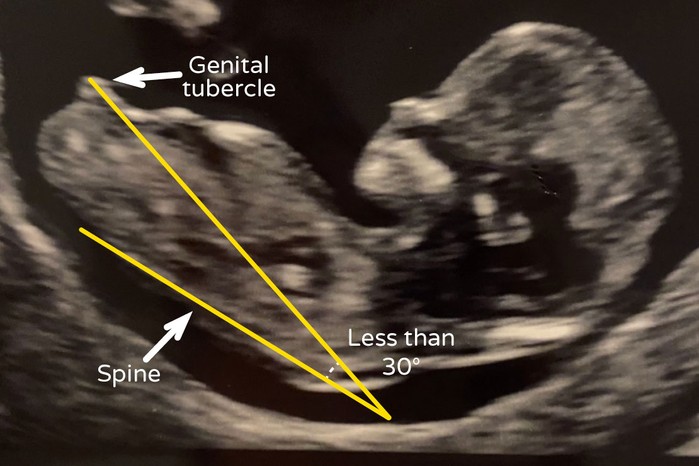
Nub theory is a method for predicting your baby's gender based on an ultrasound scan around 12 weeks. At that stage, both boys and girls have a small protuberance between the legs: the "nub." In boys, this nub later develops into a penis; in girls, it becomes the clitoris.
The difference? The angle. In a boy, the nub points upward at an angle of more than 30 degrees relative to the spine. In a girl, the nub lies more horizontally, parallel to the spine.
Sounds simple, but in practice it is trickier than it sounds.
What exactly is the nub?
The nub (also called the "genital tubercle") is a small protuberance that starts developing from 6-7 weeks after conception. In the beginning, the nub looks identical in boys and girls. Only from around 11 weeks does the difference start to become visible:
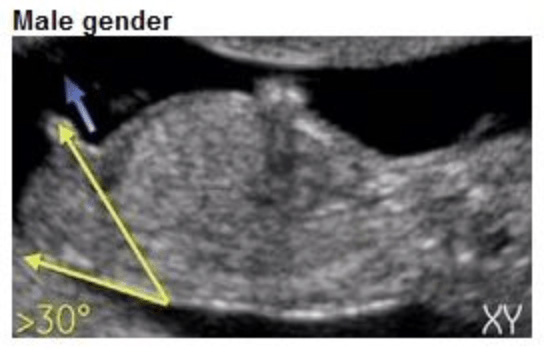
- In a boy: the nub begins to point upward, at an angle of 30 degrees or more relative to the spine. It grows into the penis.
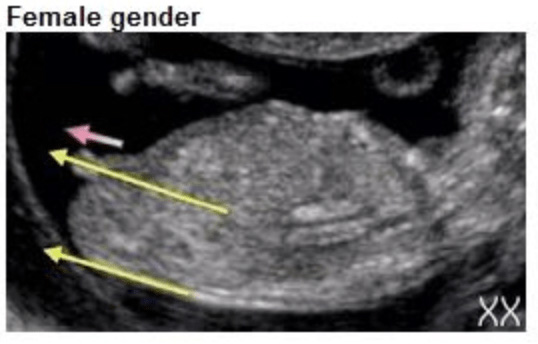
- In a girl: the nub remains relatively flat and horizontal, parallel to the spine. It develops into the clitoris.
The tricky part is that this difference is very subtle at first. At 11 weeks, the nub can be just a few millimeters in size.
ExplanationHow does nub theory work? Examples
To apply nub theory, you need a clear lateral ultrasound (a so-called "sagittal" profile). Ideally, your baby should be lying on its back with the legs visible.
How to identify it:
- Boy: look for a nub that clearly points upward, at an angle relative to the lower back. Sometimes a small thickening is already visible at the tip.
- Girl: the nub runs more or less parallel to the spine, or even points slightly downward. The tip is often slightly rounder or forked (split).
What makes it difficult?
Not every scan is suitable. If your baby is lying on its tummy, curled up, or holding its legs in front of the view, the nub cannot be properly assessed. The quality of the ultrasound equipment and the experience of the person interpreting the image also play a major role.
Tip: ask your midwife or sonographer if they can capture a lateral profile if you want to try nub theory. They are used to it.
How reliable is nub theory?
This is the question everyone asks. The honest answer: it depends on the timing.
- At 11 weeks: reliability is around 54%. That is barely better than guessing. The nub is still too undeveloped to show a reliable difference.
- At 12 weeks: reliability rises to approximately 77%. Now it gets interesting. In three out of four cases, the prediction turns out to be correct.
- At 13 weeks: reliability increases to approximately 79%. Slightly better, but still no certainty.
For comparison: at the 20-week anatomy scan, the reliability of gender determination is over 99%. And a NIPT test (from 10 weeks) is virtually 100% reliable.
In short: nub theory is a fun indicator, but not a diagnosis. Do not throw a gender reveal party based on a 12-week scan just yet.
Nub theory at 11 weeks
At 11 weeks, it is really still too early. The nub in both boys and girls is still largely undifferentiated. An experienced sonographer may sometimes spot a difference, but the chance of an incorrect prediction is almost as high as the chance of a correct one.
Our advice: if you have a scan at 11 weeks and want to try nub theory, keep the result but take it with a very large pinch of salt. It is better to wait until 12 or 13 weeks for a serious attempt.
Nub theory at 13 weeks
At 13 weeks, the nub is already considerably more developed. The difference between a boy and a girl is more clearly visible, and reliability is at its highest at 79%. If you want to apply nub theory, this is the ideal moment.
Keep in mind: even at 13 weeks, there is still a 1 in 5 chance that the prediction is wrong. It is and remains a method based on visual interpretation, not a medical test.
Nub theory examples
Many expectant parents search for examples to compare with their own scan. That is understandable, but be careful: ultrasound images vary enormously in quality, angle, and clarity. What looks like a clear "boy sign" on one scan may be something entirely different on another.
Tips when looking at examples:
- Always pay attention to the angle relative to the spine, not the size of the nub. A larger nub does not automatically mean "boy."
- Only compare with scans from the same gestational week. A nub at 11 weeks looks very different from one at 13 weeks.
- Be aware of confirmation bias: if you are hoping for a girl, you will quickly see a "girl nub." Try to look objectively, or have someone else take a look.
And most importantly: it is a fun game, not a medical result. Enjoy it, but do not pick your nursery colour based on it just yet.
Can you apply nub theory yourself?
Yes, but with a disclaimer. Online you will find countless photos and explanations, and with some practice you can learn to spot the difference. But sonographers train for years to do this, and even they are only sure in 77% of cases at 12 weeks.
If you want to try it yourself:
- Make sure you have a lateral profile scan (sagittal)
- Look for the small protuberance between the legs
- Assess the angle relative to the spine
- More than 30 degrees upward? Probably a boy
- Horizontal or slightly downward? Probably a girl
And if you really cannot see it: that is perfectly normal. The nub is sometimes just a few pixels on an ultrasound printout.
Read more
Other ways to predict gender
Nub theory is not the only method. There are dozens of ways to guess your baby's gender, from the Chinese calendar to old wives' tales about the shape of your bump. Curious about what other methods exist and how reliable they are?
Or make it a celebration: start a baby pool and let your whole family and circle of friends guess. On Baby-Hunch, an average of 15 people participate per pool, and in 61.5% of cases the majority correctly predicts the gender. Better than the Chinese calendar!
Also read

How to plan a baby shower: the complete checklist
Complete checklist: when, who to invite, food, games, decoration and budget tips.

12 fun baby shower games
From hilarious diaper challenges to a digital baby pool. Tested and approved!

Predicting baby gender: 8 methods
From Chinese calendar to nub theory: all methods compared. Plus unique data from 79,000+ parents.
Frequently asked questions
From what week can you apply nub theory?
Nub theory is most reliable from 12 weeks onward. At 11 weeks, the difference between boys and girls is barely visible. At 13 weeks, reliability is at its highest (79%).
How reliable is nub theory?
At 12 weeks approximately 77%, at 13 weeks 79%. That is better than guessing, but nowhere near as reliable as a 20-week scan (99%+) or NIPT test.
What is the difference between a boy nub and a girl nub?
With a boy, the nub points upward at an angle of 30+ degrees relative to the spine. With a girl, the nub lies more horizontally, parallel to the spine.
Can nub theory be wrong?
Yes. At 12 weeks there is still approximately a 23% chance of an incorrect prediction. The quality of the ultrasound, the position of the baby, and the experience of the person interpreting the image all play a role.
Can you apply nub theory yourself on your own scan?
Yes, but it is difficult without experience. You need a clear lateral ultrasound and the nub is sometimes only a few millimeters in size. It is fun to try, but do not rely blindly on your own interpretation.